Technical Information Page.
What Water for use in live steam locomotives.
Well, water is just water isn't it? Actually no, it's not quite that simple.
Our miniature steam boilers are made mostly of copper, with some bronze and silver solder and there are also brass steam fittings for the steam to negotiate before it exits to atmosphere. Although all these items are made from non-ferrous metals and therefore do not rust, they are subject to chemical attack in other ways. Here is a quick run down of the common sources of water with their pros and conns.
Tap water - in soft water areas, this is fine but in hard water areas it can quickly lead to a build up of 'lime scale' on the inner surfaces of the boiler, fittings and pipe work. The easiest way of establishing what your water is like is to look inside your kettle. If it's thick with white 'lime scale' deposits, avoid using it.
Rain water - free of charge and quite good if you can get sufficient quantity. It must be filtered to get all the dirt, grit and other rubbish out of it and the filters used by home brewers and wine makers does an excellent job.
De-ionized water - this is often sold for use in steam irons and the general opinion amongst the small scale live steam community is that it should not be used. Because of the way it is 'purified', it can cause long term problems by slowly removing zinc from the brass fittings - commonly called de-zincification.
Purified water - tricky one this, as it is not always clear how purification has taken place. Shops that sell it will variously tell you it is de-ionized, or distilled. If you can't be sure that it is distilled, don't use it.
De-humidifier water - another good source. A de-humidifier is a bit like a fridge in reverse, and the water that collects in the tank is quite safe to use.
Refrigerator/deep freezer ice - good. It is basically moisture in the air that has frozen and once thawed out is good to use if you can get sufficient quantity.
Distilled water - the best water you can use but unfortunately it is difficult to get hold of. If buying distilled water, be very sure that it actually is. Some retail outlets will sell 'purified' or 'de-ionized' water (for steam irons or car batteries) and tell you it is distilled but it is actually quite different.
You will probably find that a combination of these will supply all your needs but if you store or stock pile collected water, be sure to filter it well before use and change the containers from time to time. If not, you will find algae and other deposits forming in the water which will cause steaming problems. Dirt, algae and other debris can cause the water to foam as it boils and this will cause priming to the cylinders and syphoning at the safety valve.
Gas firing systems.
First, a little history:
Roundhouse haven't always produced gas fired locomotives, in fact, until 1988, all models were spirit fired, but it was introduced at that time to allow greater flexibility in design.
A single closed flue system was adopted as components were readily available from specialist manufacturers, and it was simple and compact. After some years of using bought in parts, and finding the problems and limitations of the system, Roundhouse decided it could produce a better system 'in house'.
During 1994/5, a great deal of time and money was spent on developing a new gas system that would do just what we wanted when we wanted. With the help of a number of specialist's in the gas field, including time in the Department of Fuel and Energy laboratory at Leeds University, the 'FG' gas burner was eventually developed which was easy to manufacture and is efficient, quiet and weather proof.
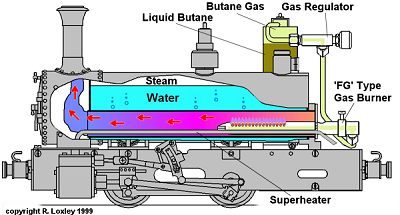
Gas, stored in the tank on the locomotive, passes through a needle valve regulator, then on to the gas burner. The burner has the job of mixing precisely the gas and air, so allowing it to burn correctly in the closed flue. The hot gasses pass along the flue, transferring heat into the surrounding water, and exit via the chimney along with exhaust steam from the cylinders. A superheater, carrying steam to the cylinders, also passes down the flue tube to ensure that the steam reaching the cylinders is as dry as possible.
When we introduced our first budget loco (Millie) this meant another lengthy development stage to produce a similarly good system for use with externally fired boilers. The 'FX' burner was the result and once again is quiet, efficient and pretty weather proof.
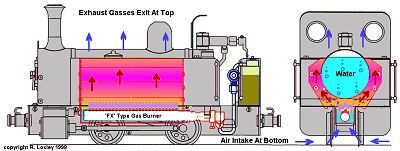
With this system, air passes up through the bottom of a firebox which surrounds the boiler. The gas burner is mounted beneath the boiler and hot gasses from this pass up, around the outside of the boiler and exit at the top. The firebox controls the passage of the hot gasses to ensure that maximum heat is transfered into the water inside the boiler and keeps out any unwanted cold air and wind. The main steam pipe passes through the firebox in large loop around the inside. This gives a certain amount of re-heating to the steam on it's way to the cylinders, but it does not afford the same level of re-heating as with the closed flue internally fired system.
Gas is carried on the locomotive in a purpose built storage tank which is filled from a gas cannister as used for filling cigarette lighters or larger types used for small blowlamps or camping stoves etc.
The most important thing to realise is that gas firing is not just down to the burner. We are dealing here with a complete system and many factors come together to make it work correctly. You can not just buy a Roundhouse burner, fit it in your own boiler and expect good results. Because of the requirements of a closed flue system of this size, every aspect of the entire system has to be 'just right' in order to get good performance and very small alterations or variations can throw the whole thing into dissarray. Every care is taken at the factory to ensure that ready to run locomotives are set up correctly and every aspect of it's operation is carefully checked, culminating in an exhaust gas analysis test to see just how efficiently it is working
Preferred gas fuel.
Ordinary Butane or Iso-butane gas (as used in gas cigarette lighters) is the preferred fuel, though for economy, the larger canisters as used for blowlamps or camping stoves etc. are better. The larger canisters have an EN417 threaded self sealing valve on top and require a special adapter to couple up to the filler valve on the locomotive.
Mixed gasses, i.e. Butane with a proportion of Propane mixed in, are available, and may be used on current models (PLEASE NOTE EXCEPTIONS BELOW) if straight Butane is unavailable. These come in a variety of mixes ranging from 90/10 to 60/40 with one of the most common being 70/30. The figures refer to the proportions of the mix i.e. 70/30 contains 70% butane and 30% propane. If using mixed gasses, always choose the one with the largest proportion of butane. The addition of propane slightly alters the gasses properties. This can make the burner a little more difficult to light when cold or after filling the gas tank.
Always open the regulator very slowly when lighting, and only just sufficient for ignition to take place. Opening too much too soon may extinguish the flame until the burner reaches normal operating temperature.
Due to the higher storage tank pressure of mixed gasses, they should not be used in the following models.
- All Roundhouse Beck locomotives.
- Early 'Lady Anne', 'Dylan', 'Old Colonial' and 'Charles Pooter' models with external gas firing,
- Early 'Lady Anne' and 'Dylan' models with rectangular gas tank in the right hand side tank.
- Any models with 1" square, vertically mounted gas tank in the cab.
- Early 'S.R. & R.L #24' and 'Fowler' with one piece rectangular gas tank.
Replacement gas tanks suitable for mixed gasses are available for models in catagories (5) & (6), enquire for further details.
Basically, we have an excellent system that works well but if you want to incorporate our parts into your own locomotive, ask our advice. We do offer certain parts in our range of 'Home Builder Parts', but it is not always a simple matter to achieve the correct results. A range of shapes and sizes of gas tanks are available.
Cylinders.
All current Roundhouse locomotives are fitted with a pair of 9/16" bore x 5/8" stroke double acting cylinders, which are operated by slide valves housed in a valve chest on top of the cylinder block. The valve spindle gland nut uses a 1/4x40ME thread and the piston rod gland nut uses a 5/16x32ME thread.
Simplified Walschaerts valve gear.
We use the description 'simplified' because it does not include a functioning combination lever/union link/drop link, it does offer forward and reverse running but not variable cut off. Used in conjunction with the Roundhouse cylinders, very slow steady running is easily achieved.
Quality materials are used throughout - rods and links are laser cut in stainless steel - return cranks and lifting arms in cast nickel silver - stainless and silver steel also used in other parts where appropriate.
Available as a complete set - not including coupling or connecting rods - for the home builder and includes full instructons for assembly and setting. Part code:WVG
Steam oil.
'Steam oil', to use it's common name, comes in many forms and weights and often under some other name. There seems to be a commonly held belief on this subject, that 'thicker is better', but this is just one more 'old wives tale'. Also, to say that a certain viscosity of oil is correct for all, without any other qualification (eg. at certain steam pressures, temperatures or pipe size etc) is a little misleading. It may work fine in one design of engine, but be less suitable for another. By choosing the correct weight and composition of oil, you can obtain a more efficient lubrication.
There are a number of things to be taken into consideration when deciding which oil to use such as, temperature of steam, size of piping, point of entry into stsyem, type of lubricator etc. etc.
The current oil supplied by Roundhouse is, to use it's correct title, 'Compounded Bearing Oil 220' (220 being the weight or viscosity) and was chosen after consultation with the oil's manufacturer and discussion as to its precise application and working environment. The change of oil was brought about a few years after Roundhouse adopted internal gas firing and a small number of engines were experiencing blocked super heater pipes after prolonged use. The blockages were caused by carbonised oil, though this had never been a problem with the earlier externally fired models..
Here is a short explanation of our displacement lubricators mentioned above.
This simple but effective device, takes care of lubricating the inner working parts of the cylinders. It is called a displacement lubricator because of the way the condensed steam displaces the oil in the chamber. It comprises a hollow chamber with the steam pipe passing through and has a filler cap at the top and drain at the bottom, both of which seal against the internal pressure. The steam pipe has a small hole in it, within the chamber, to allow the transfer of steam and oil to the cylinders. Before use, the lubricator is filled with 'steam oil' (as described above).
Safety valve.
The safety valve controls the maximum pressure allowed to build up inside the boiler and is an important safety device. All Roundhouse locomotive boilers have a single safety valve set to prevent pressure from raising above 40psi (pounds per square inch). The unit screws into a bush in the boiler with a 5/16" x 32 ME thread.